
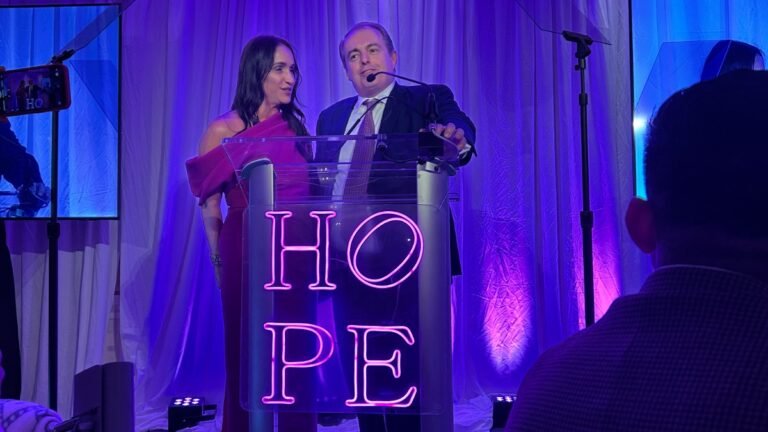
“My father’s ‘rule of thirds’ philosophy was built around work, family, and sharing goodness with others. It gave me balance, and balance is my definition of success.”
Ambitious professionals and entrepreneurs share a common trait: an inner fire for success that is difficult to extinguish by external challenges. Immigrant entrepreneurs, however, stand out for an additional strength, one rooted in the values of sacrifice and devotion to family. These values make them more resilient in the face of adversity.
They inherit values, not financial wealth. Richard Lukaj embodies this social reality, where the drive for growth, combined with strong family traditions, enables sustainable and lasting success. The Albanian-American founder and CEO of Bank Street in the United States began his career on Wall Street.
In an interview with Vaspas, Mr. Lukaj reflects on a journey shaped by hard work and education, as well as by the memorable advice of his father. Early on, he learned that true success lies in balance and in contributing to society, alongside growing one’s business and nurturing love for family.
Mr. Lukaj has over 20 years of experience in investment banking. He has originated and executed more than 200 transactions with a total value exceeding $100 billion. As a co-founder of Bank Street, together with his partners, he has worked to build a premier investment banking platform focused on high-growth sectors of the global economy.
During his time at Bear Stearns, he played a significant role in the development of one of Wall Street’s most powerful investment banking platforms. While his experience is primarily concentrated in the Media, Communications, and Technology sectors, he also has extensive expertise across a wide range of industries, including Industrials, Consumer, Retail, Energy, Aerospace, Specialty Finance, Real Estate, and Natural Resources.

An active member of several Albanian organizations, Mr. Lukaj is also one of the most prominent philanthropists within the Albanian community worldwide.
Read the full interview:
You founded and have led Bank Street Group for more than 20 years. How would you describe that journey, and how do you view it today compared to your expectations at the beginning?
Our journey did not begin with grand ambitions or a detailed master plan. It started with an open mind and a willingness to explore how talent and experience could engage with a new paradigm, at a time when technology was fundamentally reshaping Wall Street.
We experimented extensively. We made mistakes. But we also did many things right. What worked was grounded in timeless values: honesty, transparency with clients, and an uncompromising work ethic. Technology and data were available to everyone, but we applied them in a way that distinguished us.
Over time, what began as an experiment evolved into a dependable group of individuals. That group became a brand associated with quality. The path was not laid out in advance, but it was paved over time through lessons learned, best practices developed, and trust earned. Through that trust, we ultimately achieved results that rival the best firms in the world.
Looking back, it is difficult to say whether we exceeded expectations, because there was no clear benchmark at the outset. In many ways, that was our advantage. Trying to map a precise path to achieving the impossible often results in never trying at all. We began with aspiration rather than a blueprint and built the plan as we moved forward.
I was still young enough, and perhaps naive enough, to believe that seemingly impossible things could be done. I had seen companies go from ideas to enterprises that changed the world. Those experiences conditioned me to believe that David can defeat Goliath. That belief, combined with perseverance, youth, and the ability to inspire others to take risks alongside me, ultimately contributed most to our success.
Today the world is experiencing rapid technological change. How does an investment bank operate in this environment?
The short answer is that it is probably all three, leading, following, and moving alongside technology, depending on the context.
As a firm, we are highly focused on technology enablement, which means we are often early adopters. At the same time, because we work across a wide range of technologies, we understand the risks and limitations that come with them. Some tools become industry standards. Others require real caution.
As an operator, I have the responsibility of understanding what technology truly means for the firm, including security, efficiency, economics, and the ability to turn data into insight. How technology is integrated is often where differentiation comes from.
At its core, investment banking remains a human business. Technology does not replace judgment or relationships. It enables people to perform at a higher level. The firms that distinguish themselves are not those with access to the best tools, because most firms have access to the same tools, but those that integrate technology most effectively with human capital.
There is also an external dimension. Our firm has long been involved in enabling technological progress by raising capital and advising companies in communications technology and digital infrastructure.
That same discipline applies today as we enter the AI era. We are experimenting carefully within controlled environments, focused on productivity and leverage rather than reckless adoption.
You became an entrepreneur after roughly 12 years on Wall Street. What shaped you more there, success or failure? Can you share a setback that transformed you?
It was both, but not in a simple or linear way. Success gave me skills, experience, and confidence. The moments that truly shaped me, however, were periods of uncertainty, when clarity and direction were not obvious.
When I left Wall Street, I had experience and a professional reputation, but emotionally it was also a reset. I did not set out to start a firm with a fully formed plan. I gave myself space to think, to reset, and to stay active professionally while I figured out what the next chapter should look like.
I began joining boards, investing, advising companies, and helping businesses that were struggling or just getting off the ground. Some of it was not even about money. It was about staying engaged and regaining purpose. Over time, clients began reaching out again and transactions started coming in, creating real momentum and giving shape to what would eventually become the firm.
That period taught me something important. Transitions are not always clean breaks. Sometimes progress comes from staying in motion until opportunity finds you. Wall Street taught me discipline and execution. That uncertain stretch taught me resilience, patience, and the willingness to build without certainty. Both were essential in shaping who I became as an entrepreneur.
Have you ever had a moment where you thought that if you failed that day, your life would have taken a completely different direction?
We operate in a profession where the stakes are exceptionally high. Every decision carries weight, and there is a constant awareness that a serious mistake could fundamentally alter your career. That reality creates pressure, but it also sharpens discipline and accountability.
There were moments that genuinely could have defined my life. I remember being 27 years old and persuading my firm to commit to a multi-million-dollar capital position based almost entirely on my analysis and judgment. That decision did not just put my reputation on the line. It placed responsibility on me for colleagues, clients, and the firm itself at a time when there was little margin for error. Had that transaction failed, it would not have mattered how many successful deals came later. I would have been remembered for that moment.
On a personal level, there were also periods of profound challenge that forced reflection and growth. Life does not provide a manual for navigating every situation, and there are moments when decisions made with good intentions do not produce the outcomes you expect. Those experiences test your judgment, your resilience, and your sense of self.
What I learned is that time and perspective matter. As you gain distance from difficult moments, you are able to see them more clearly, understand what you learned from them, and place them in proper context rather than letting them define you. Perseverance is not about ignoring setbacks. It is about absorbing their lessons, adjusting course, and continuing forward with greater clarity and humility.
As careers develop gradually, success may not feel surprising. Did you ever feel that you had arrived among the big players?
In my experience, the idea of “arrival” is somewhat misleading. Early in my career, I believed there would be a moment when you finally arrive, when you feel you have crossed into a different league. What I eventually learned is that truly successful people are largely the same people they were when they had very little.
By my mid-twenties, I became less focused on proving myself and more focused on understanding what kind of professional I wanted to be. The circles change, the scale changes, but the underlying values tend to remain consistent. Across geographies, cultures, and markets, people value honesty, competence, and reliability in remarkably similar ways.
Success, as I came to understand it, is not a destination. Many people equate it with wealth, but I have known extremely wealthy individuals who were not successful as human beings. Real success is being at peace with who you are, being reconciled with your past, and creating value without compromising your integrity or harming others.
What was the most difficult professional decision you ever made, and what did you learn from it?
The most difficult and consequential professional decision I ever made was choosing my business partner.
When you are building something from the ground up, especially in a business as demanding as investment banking, the choice of partner becomes fundamental. A partner is not just someone you share economics with. They influence how decisions are made, how risk is evaluated, how people are treated, and how the firm behaves when it is under pressure.
At the time, the firm was functioning and gaining momentum, which made the decision more complex rather than easier. Bringing in a partner meant being intentional about the future of the business. It required giving up a degree of control and accepting that not every decision would be made exactly as I would make it.
What ultimately made it the right decision was the challenge that partnership creates. A strong partner questions assumptions, pushes back when necessary, and forces you to think more carefully before acting. Over time, that dynamic strengthened the firm and improved the quality of decisions. It also made the journey more sustainable, because building something meaningful over decades is not something anyone should do alone.
The lesson for me was clear. Skill and effort matter, but alignment, trust, and shared values matter more. Choosing the right partner does not always make the day-to-day work easier, but it makes the long-term outcome far stronger.
Finance is often perceived as ruthless. How did you preserve your integrity?
Finance often carries a reputation that is shaped by its most visible failures rather than by the quieter reality of how most serious professionals actually operate. In practice, much of the work is built on long-term relationships, judgment, and mutual reliance. That environment only functions when people trust one another.
From early on, I became aware that every career is shaped not only by the opportunities you pursue, but also by the ones you decline. Over time, I learned to pay close attention to the people behind the opportunity, the culture surrounding it, and the way decisions were made when circumstances became difficult.
There were moments when choosing not to participate in certain environments meant taking a slower or narrower path. Sometimes that meant passing on transactions that looked attractive on paper but came with expectations or practices that did not align with how I wanted to work.
In the longer term, however, those decisions created something far more valuable. They allowed me to build relationships with people and institutions where integrity was not something you had to negotiate or defend, but something that was assumed. Working in those environments made the work more sustainable, the partnerships more durable, and the outcomes more meaningful.
Preserving integrity is rarely about one dramatic stand. More often, it is about a series of quiet decisions made consistently over time. That consistency shaped my career in ways I am grateful for.
If you had to define your work philosophy in one word, what would it be?
Trust.
Over time, I have come to see trust as the foundation of every meaningful professional relationship. It is not created by a single action or success, but built quietly through consistency, transparency, and follow-through over many years.
Trust takes time to earn and care to maintain, and it can be weakened quickly by shortcuts or compromises. That reality forces discipline. It shapes how you make decisions, how you communicate, and how you behave when circumstances are difficult rather than convenient.
In the end, trust is what allows relationships to endure, especially in moments of uncertainty. It is also what gives your work meaning beyond any individual transaction. That belief has guided how I have approached my career from the beginning, and it continues to shape the choices I make today.
Your philosophy around life and impact has evolved. What shaped that evolution?
My philosophy evolved gradually and, in many ways, brought me back to where I started.
I grew up with strong family values and a desire to be a good human being. In my twenties, I became very focused on professional success, believing that achievement would naturally lead to fulfillment. As the career progressed, I found that while professional progress can be energizing and meaningful, it does not, on its own, create balance or a sense of completeness.
A conversation with my father was especially formative and stayed with me over the years. He told me that I was becoming too narrowly focused on my professional life and that I should be careful not to confuse achievement with fulfillment. He said that when people look back on a life, they rarely remember titles, deals, or income. They remember how you made them feel and whether you showed up for the people who mattered.
He described what he called the philosophy of thirds. One part of life is professional, and it matters because it gives structure, purpose, and the ability to create. Another part is family, which he believed should come first because it provides stability, perspective, and continuity through every phase of life. The third is giving back, taking the opportunities you were given and using them in ways that benefit others and help create paths for those who come after you.
What struck me most was his emphasis on balance. He warned that even good things can become destructive if they define you entirely. A meaningful life, he explained, is not about excelling in a single dimension, but about finding equilibrium among them.
That conversation changed how I measured success. Fulfillment, I learned, comes from maintaining that balance over time. I have tried to live with that awareness ever since, and it has shaped how I think about responsibility, impact, and what it ultimately means to live a well-rounded life.
What is the most valuable advice you received from your parents?
The most valuable advice I received from my parents was not a single directive, but a way of living they demonstrated consistently. Family came first. People were treated with dignity. Honesty mattered in work, and giving back was simply part of responsibility, not an exception.
At the time, those lessons felt simple, even self-evident. With experience, I came to understand how rare and powerful they actually are. In moments of uncertainty or pressure, those principles provided a steady framework for decision-making. They guided me toward long-term integrity rather than short-term gain and reminded me that how you conduct yourself ultimately matters as much as what you achieve.

What was the greatest emotional challenge of your journey as an immigrant child?
One of the greatest emotional challenges of growing up as an immigrant was the persistent feeling of being slightly out of place. Even when you are welcomed, there is often an unspoken pressure to adapt quickly, to blend in, and to prove that you deserve to be where you are.
As a child and young adult, that sense of difference often translated into working harder, observing more closely, and questioning yourself more than others might. While it can be motivating, it can also create a subtle insecurity that stays with you longer than you realize.
As I grew older, that feeling began to change. I came to understand that belonging does not come from recognition, approval, or status, but from contribution. When you recognize the value you bring and allow yourself to take ownership of your place, confidence begins to settle naturally. That realization was an important turning point for me and continues to shape how I see myself, other immigrants, and the idea of belonging more broadly.
What message do you have for young people facing global competition today?
It is easy for young people today to feel overwhelmed in a world that constantly invites comparison and quick judgments about success. Social media, visibility, and speed can create the illusion that everyone else has figured things out early. My advice is to focus less on having everything mapped out and more on beginning the journey with intention.
Be curious and stay open to learning. Approach your work with care, integrity, and a willingness to improve. Most meaningful paths do not reveal themselves all at once. They unfold gradually, often through experiences and relationships you could not have predicted at the start.
Rather than measuring yourself against others, focus on building experience, developing character, and contributing value wherever you are. Those habits may not produce immediate validation, but they compound quietly over time. In the long run, they tend to be far more durable and far more rewarding.